


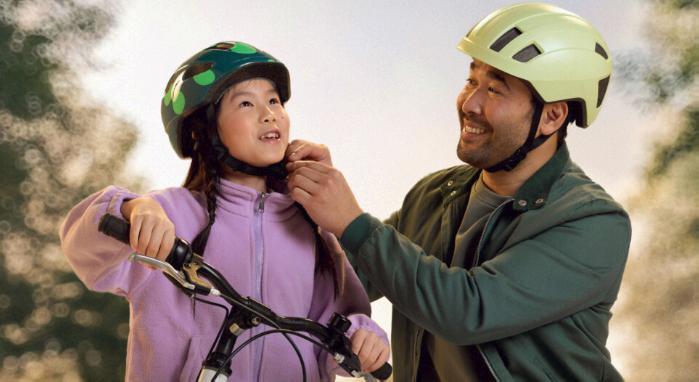
Photo: Screenshot from Helmet Week
The prompt for this essay came from a discussion we had with our community members about bicycle helmets, as well as this recent ironic article about the Dutch Helmet Week.
A bit of background about this campaign: in the Netherlands, as of 2022, road deaths are the highest among cyclists, with two-thirds of them attributed to head injuries, as reported by the Dutch Central Bureau for Statistics. The response has been this campaign, that urges cyclists to wear helmets. The article above calls it a “performative concern”: the institutional capacity to feel good about a problem while ensuring it remains structurally unchanged. From the article:
“Adults across the The Netherlands will crouch down to child height, fasten a small piece of foam to a small human head, and feel that they have done something. They have not lowered the speed limit. They have not built a protected lane. They have not questioned, for even a moment, their right to drive a two-tonne vehicle through a school zone at full urban speed. But they have bought the foam. And they have given it to the child. And now the child is responsible.“
If we look at the data a bit more closely, we see that an average of 42% cyclist fatalities mentioned above were in a collision with a car (54% if we include all motor vehicles). Helmets don’t help here: they are designed to withstand minor knocks and falls, not collisions with fast-moving cars or lorries.
The 2nd highest percentage, at 31%, is “no collision” (for example, an awkward fall) – and this includes mostly older people: of the cyclists aged 70 or older who died in an accident, 36 percent had not had a collision. In fact, many elderly people in the Netherlands do wear a helmet. As part of a series of interviews, an older man said: “it is only inevitable that one day I will fall,” which is why he had recently started wearing a helmet.
And wearing a helmet is also not without risk. A study showed that drivers may pass closer to cyclists wearing helmets, falsely believing that the chances of an injury from a collision may be lowered due to the helmet. Compulsory helmets also have negative effects at population level, as having to wear a helmet puts some people off cycling, and makes it harder to use bicycle-sharing schemes. Research shows that relatively minor reductions in cycling on account of a helmet law are sufficient to cancel out, in population average terms, all head injury health benefits.
All this is to say, helmet campaigns and compulsory helmet laws are an unsuitable solution to the problem of road safety for cyclists. To be clear, we are not saying you should not wear a helmet – personal protective equipment is a personal choice. What we are saying is that helmets do not solve the structural issue, and discussing helmets takes attention and resources away from structural solutions.
📥 Would you like to receive articles like this one straight to your mailbox every month? Subscribe to our newsletter!