


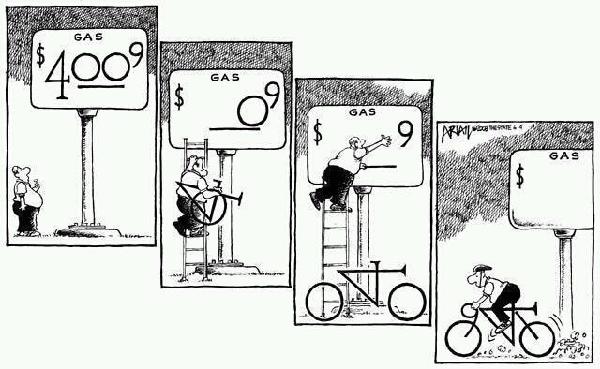
Cartoon by Robert Ariail
The war in Iran has led to a global energy crisis, and road transport, which accounts for about 45% of global oil demand, has been severely affected. Various organizations have published recommendations for reducing oil use, and if you squint, you will see switching from cars to bicycles as a proposed solution., which for us of course goes without saying.
For example, the International Energy Agency recommends switching from private cars to public transport to reduce oil use, adding that “options such as cycling and walking for shorter distances can lead to further reductions.”
The European Commission’s AccelerateEU plan includes measures to promote cycling (in the Annex, not in the main report – we don’t want to upset those pesky car lobbyists!), such as further developing cycling infrastructure, support for bike-sharing schemes, and financial incentives for the purchase of bicycles.
The European Cyclists’ Federation has published its own proposals, which focus on cycling as a solution to the energy crisis and rising travel costs. It proposes ten measures: five short-term, such as reintroducing temporary COVID-style cycle lanes, and five long-term, such as allocating at least 10% of budgets to sustainable mobility.
In Greece, the government is providing subsidies to address the energy crisis. This works as a short-term measure, but it does not solve the problem of oil dependence. In the Netherlands, the 1973 oil crisis was one of the factors that changed the country’s path away from the car and onto sustainable mobility. In the UK, drivers are already turning to walking and cycling as fuel costs rise. Why not in our country too?
Let’s take a closer look at two of the proposed measures:
“Last-mile delivery” by bike
“Last-mile delivery” is the final stage of delivery, where a product is transported from the nearest distribution centre to the customer’s door. Bicycles, and especially cargo bikes, can make deliveries in densely populated urban areas greener, cheaper, and faster, which is why they are one of the areas included in the European Commission’s AccelerateEU plan.
Imagine small distribution centres located on the outskirts of city centres, where trucks deliver products, which are then picked up and distributed by a fleet of cargo bikes. In London, the Urban MicroHub Alliance is a new collaboration of organizations that take empty or underused spaces (e.g. parking lots) and turn them into such distribution centres for use by many different logistics companies.
In Greece? In a recent episode of the podcast “Πάμε για Ποδήλατο;”, Michalis Keskinidis of Pedal Courier explains how a bike courier service works, and mentions the possibility of using bicycles for last-mile deliveries: Bike courier in Athens (in Greek).
Car-free Sundays
One of the ten proposals of the European Cyclists’ Federation is the organization of regular car-free Sundays.
We have already mentioned the effect of the 1973 oil crisis on the Dutch shift towards cycling. To reduce oil consumption, the Dutch government banned cars on Sundays for three months from November 1973.
“The decision of not using cars on Sundays made it clear that societies could do without them for one day. And it looked fantastic. There were picnics on motorways and kids playing in the street.” (Jan Wittenberg, first president of the Dutch Cyclists’ Union)
Although there were already campaigns for road safety, the Car-Free Sundays made a larger part of the population (and especially politicians) aware of the consequences of car dominance on the roads. The three-month measure was followed by a series of structural changes to promote sustainable mobility.
The story from the Netherlands shows that a crisis can become an opportunity for transformation. And in Greek cities, transformation is urgently needed.
📥 Would you like to receive articles like this one straight to your mailbox every month? Subscribe to our newsletter!