


When discussing the relationship between women and mobility, many assume that the automobile was the great tool of emancipation. But that is not the case. Long before the car conquered the roads, it was the bicycle that granted thousands of women an unprecedented level of autonomy, freedom of movement, and access to public space.
In the late 19th century, the bicycle became closely linked to the first feminist movement. For the first time, women could travel independently, without a chaperone, and without relying on horses, carriage drivers, or family members. Cycling challenged social norms, transformed the way women dressed, and contributed to the pursuit of greater social and political freedom. Feminists viewed the bicycle not merely as a means of transport, but as a tool for liberation, one that enabled women to break free from the physical and social constraints of the era.
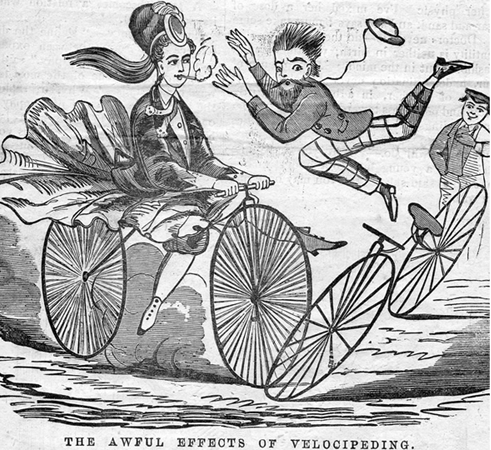
As expected, women’s relationship with the bicycle provoked strong reactions. Cartoons from that era vividly capture this fear of female independence.
With the rise of the automobile, car manufacturers and advertisers sought to convince women that the car would liberate them from the constraints of the home. Indeed, women gained greater mobility and access to employment, services, and social life. However, as both Ruth Schwartz Cowan in More Work for Mother and Virginia Scharff in Taking the Wheel demonstrate, a car-centric society created new forms of invisible labour. The shift from compact, walkable neighborhoods to suburbs and dispersed land-use patterns turned many women into “full-time drivers“, transporting children, running errands, caring for elderly relatives, and coordinating family life. Driving became integrated into domestic labour without ever being recognized as “work.”
This does not mean that the automobile is inherently oppressive. As Zack Furness explains, technologies are not neutral; rather, they acquire social meaning through the systems and values that surround them. The automobile became linked to a development model that prioritized long distances, suburban sprawl, and a reliance on private motorized transport. It offers “emancipation” only because we have reorganized our lives so they become difficult without it. Thus, the automobile has created a new form of dependency: on vehicle ownership, on the costs of its use, and on a city designed around it.
In contrast, the bicycle remains a tool that grants its user direct control, it requires neither expensive fuel nor complex technical expertise, nor does it depend on large-scale industrial infrastructure. Furness describes it as a “convivial” technology, one that enhances autonomy and allows individuals to shape, for themselves, how they navigate the city.
The history of women and the bicycle reminds us that freedom lies in the ability to choose how we move. In many Greek cities, women find themselves needing a car for trips that, under different circumstances, could easily be made by bicycle. A lack of cycling infrastructure, combined with a sense of insecurity stemming from the dominance of the automobile, forces many women to rely on an expensive and demanding mode of transport to ferry children around, run errands, or commute to work.
The goal is not for women to change their habits, but for cities to change, so that women can move about safely and comfortably. And this is within our power. More than a century ago, the bicycle gave women the freedom to move on their own terms. At a time when cities are seeking ways to become more human-centred once again, this promise remains just as relevant.
📥 Would you like to receive articles like this one straight to your mailbox every month? Subscribe to our newsletter!