


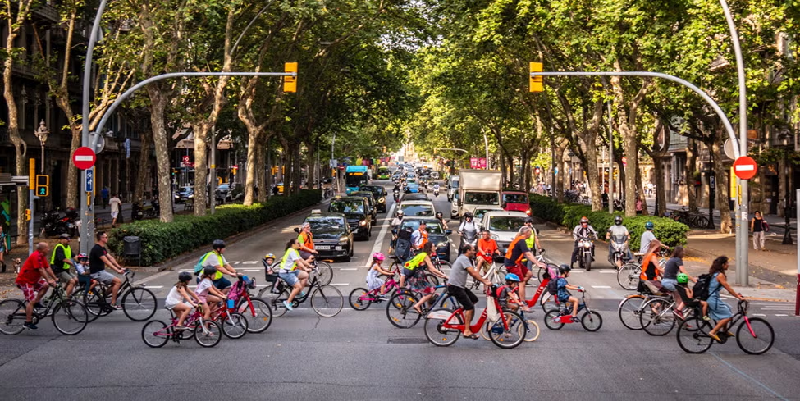
Imagine: it’s early morning, and kids everywhere are leaving for school. Neighbourhood roads slowly fill with children of all ages chatting, laughing, chasing each other, passing a football back and forth, cycling, scooting. Not a car in sight. The entire street is a playground, a chance to chat with friends before the bell rings, mind and body alert and in the perfect mood for learning.
Is this hard to imagine? Before the age of the automobile, the streets did, in fact, belong to the kids (and adults). Kids were actively ousted from the streets, as the book “Fighting Traffic” by Peter Norton explains (it refers specifically to the United States, but it was a similar story elsewhere, delayed by a few years). In the 1920s, when the number of cars started to increase and with it the number of children killed by cars, judges routinely ruled that “a child has an absolute right to use the street”, and motorists who argued that they were not at fault, because the child had rushed out in front of them, were told, “That’s no excuse. You chose to operate a dangerous machine that gave you, the driver, the responsibility.” Then the automobile industry took to the offensive, jaywalking was invented, “school-safety” education campaigns were introduced, and kids ended up in fenced playparks.
I won’t go over the negative impacts of cars in cities (you can read about some of them here), but here’s what research tells us about children specifically: children experience worse air pollution than adults because they breathe faster and their breathing height is at a similar level as the location of vehicle tailpipes. Air pollution slows lung growth in children, and it is also associated with some forms of cancer and cognitive difficulties in children. Car dependence is linked to the global physical inactivity epidemic, which sees approximately 80% of adolescents not meeting the World Health Organization physical activity guidelines, and this in turn is linked to childhood obesity, and mental health issues.
In Greece, only 21%, 15% and 13% of children aged 11, 13 and 15 respectively are sufficiently active, and 4 in 10 children aged 7-9 are overweight or obese.
I don’t think that anyone really wants this for our children. Is it not time to reclaim the streets for them? Here are a couple of steps in the right direction, for inspiration:
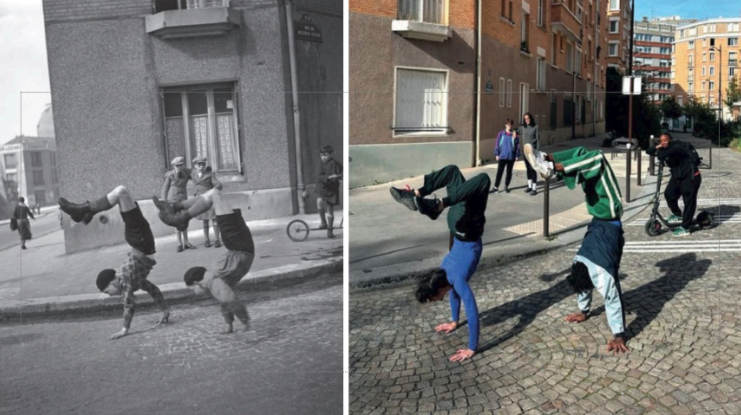
✅ “Rues aux écoles” in Paris involves pedestrianizing streets adjacent to schools, and converting the space previously taken up by parked and moving cars into a place for children to play, parents to gather before and following the school day, pedestrians and cyclists to travel through, and residents and patrons of local businesses to linger and enjoy.
What I love is that they actively involve children in the design of these streets. Priscilla Benedetti, an Urban Planner with the City of Paris, said: “We retook old photos of Paris where kids played in the streets — and asked today’s children to recreate them. It was a way for them to re-own the streets again.”
✅ The bike bus is an organised cycle ride to and from school, that kids can join or leave anywhere along the route. There are adults “Drivers” at the front, and guiding riders across junctions along the route. Watch this video with examples of bike buses in Glasgow and elsewhere, that I’m sure will put a smile on your face.
We’d love to hear your thoughts. Are you inspired to reclaim your neighbourhood streets? Get in touch with us!
📥 Would you like to receive articles like this one straight to your mailbox every month? Subscribe to our newsletter!