Skip to content
Home » Induced Demand for other modes of transport

Induced Demand for other modes of transport

A few years ago, I travelled from the UK to Greece by train and boat. We arrived at the port in Patras, which is about 3 km outside the town, and a bunch of foreign tourists and I went to wait at the bus stop, for the bus into the centre. There was no timetable posted at the bus stop, so, being the only Greek speaker, I thought I’d ask in the port building about the bus.

I asked three people, and got three different answers:

“Yes, there is a bus, but I don’t know the timetable.”

“No, there is no bus.”

And my favourite: “Is there a bus there right now?” My confused face told him there wasn’t. “If not, then there is no bus.”

This is an example of bad bus service, which literally drives people away – in taxis.

I don’t know if the bus ever came. But if you saw it later, driving empty down the road, you might think: “well, clearly nobody wants to use this bus, we should just cut the service”. And yet, many people would use this bus, if it followed a clear and frequent timetable, and linked with other modes of travel, such as the ferry, or the train.

This post is a follow-up to my previous one, because I wanted to add the opposite view of induced demand: induced demand for other modes of transport. “People are currently not using buses very much – therefore we don’t need buses” is the negative equivalent of “there are too many cars on the roads – therefore we need more roads”. (Although no one ever says this about cars: “there aren’t a lot of cars on this road – let’s make it pedestrian!”)

Once again, we’re making the implicit assumption that there is a set number of bus users. In fact, if bus service improves, more people will use the bus.

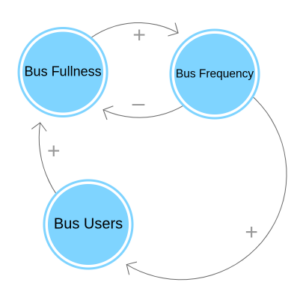
Here’s the Systems Thinking diagram, strikingly similar to the one in the previous post.

System Dynamics diagram of induced demand for bus services

If we increase the bus frequency, in the very short term buses will be less full, as existing passengers will “spread out” during the day. But in the longer term, frequent buses make more people choose them as their preferred mode of transport, so buses actually get busier.

This is a positive reinforcement loop of the good kind! And everyone should want full and frequent buses – it even benefits car drivers.

The same is true for bicycles: “this bike lane is pretty empty – therefore there are no people interested in cycling, let’s remove it“. No! Create joined-up cycle routes, that include separate bicycle paths on main roads, an extensive network of calm back roads, and frequent bicycle parking, and let’s see for how long that bike lane remains empty. I’ll leave the modelling diagram to you as homework.

We get a similar increase in active travel when we put up modal filters that allow bicycles to go through a neighbourhood, but not cars, that now have to go the long way around. This is very unpopular with car drivers before it is implemented, because they imagine their travel time will increase, for no benefit, as “there are no bicycles”.

In turns out that after implementation, these modal filters are usually popular with everyone: bicycles magically appear and make use of the safer streets, the neighbourhoods no longer suffer from polluting cars cutting through them on their way elsewhere, and travel times actually improve for car drivers!

A great example of this comes from the city of Ghent in Belgium. In 2017 they implemented a Circulation Plan: the city centre was divided into six zones (around the central car-free zone), and modal filters make it impossible for cars to drive directly from one zone to the other. Instead, cars have to drive out to the ring road around the city, and then come back in. (It is worth watching this video about the Circulation Plan, and wish for this kind of political bravery in our capital city…)

There was a lot of opposition during the consultation phase, but now most citizens are very positive about it, as it has greatly improved health, safety, and liveability in the city centre. It has also resulted in a decrease in car use, and an increase in public transport and bicycle use. The decrease in car use means that traffic is better for those who need to drive. Even though they have to travel longer distances, the time it takes to get from the ring road to the centre of Ghent has decreased. Everyone wins.

Here’s the Systems Thinking model for those interested: https://bit.ly/4r2mobK

What we need to remember is that no one is exclusively a car driver, a pedestrian, or a cyclist. We choose the mode of transport that is most convenient, affordable, safe, and comfortable.

Just as cars fill the space they are given, let’s give pedestrians, cyclists, wheelchair users, and users of public transport more space. Let’s fill our public space with people instead of cars. Everyone wins.

Τηλέφωνο

(0030) 210 2016500

e-mail

info@citiesforcycling.gr

Διεύθυνση

Ψυχάρη 45, Αθήνα

Ακολουθήστε μας

© Copyright Cities for Cycling 2023, All Rights Reserved