
Skip to content
Home » Why more lanes don’t fix traffic

Why more lanes don’t fix traffic

I spent the last couple of months of 2025 reading the Power Broker, by Robert Caro. It is a magnificent book, with an unfortunate side effect: it makes you want to talk about it to anyone who will (or will not) listen. For two months, my husband had to put up with me bringing up New York’s highways at every. possible. opportunity.

I have no regrets. The book is nominally about Robert Moses, the “master builder of New York”, but it is also about power, and democracy, and how car-centric development (mis)shaped New York in the 20th century.

Here’s how Robert Caro talks about the effect new roads had on congestion, demonstrating his masterful use of words and pauses:

“The Grand Central, Interborough and Laurelton parkways opened early in the summer of 1936. […] One editorial opined that the new parkways would, by relieving the traffic load on the Southern and Northern State parkways, solve the problem of access to Moses’ Long Island parks “for generations.”

The new parkways solved the problem for about three weeks.”

The book makes it clear that planners already knew in the 1930s that without a balanced transportation system, that included mass rapid transit, new or wider roads not only would not allievate congestion, but would make it worse.

In Caro’s words: “Watching Moses open the Triborough Bridge to ease congestion on the Queensborough Bridge, open the Bronx-Whitestone Bridge to ease congestion on the Triborough Bridge and then watching traffic counts on all three bridges mount until all three were as congested as one had been before, planners could hardly avoid the conclusion that “traffic generation” was no longer a theory but a proven fact: the more highways were built to alleviate congestion, the more automobiles would pour into them and congest them and thus force the building of more highways – which would generate more traffic and become congested in their turn in an inexorably widening spiral that contained the most awesome implications for the future of New York and of all urban areas.”

We now call “traffic generation” “induced traffic demand”: Road capacity expansion directly generates a proportional increase in traffic, so that congestion quickly returns to pre-expansion levels, or worse.

We make two assumptions when we think that we can solve congestion by adding road capacity: first, we assume that there is a set number of cars in the roads, travelling from A to B; and second, we assume that A and B are fixed. We imagine traffic as a set of glass tubes with balls rolling through them. If 10 balls want to go from A to B, it makes sense that adding more tubes in parallel between A and B would allow the 10 balls to spread out and get to B faster. In reality, the number of cars in the roads is not set: it could increase or decrease, depending on whether we make driving more convenient (e.g. by opening a new road) or less convenient (e.g. by making parking more expensive). And A and B are not fixed: a nice new road makes it possible for people to live further away from work, so that the A-B distance becomes much longer.

Another way to look at “induced demand” is using Systems Dynamics, a modelling approach for understanding complex systems. The diagrams below are “causal loop diagrams”, which are maps of the system, showing interactions between its components.

On the left, we see the system as we would like it to be: an increase in traffic results in an increase in road capacity (this is why there is a + sign on the top arrow), and the increase in road capacity reduces traffic (the – sign on the bottom arrow). This is a “balancing” feedback loop, which does keep traffic at check.
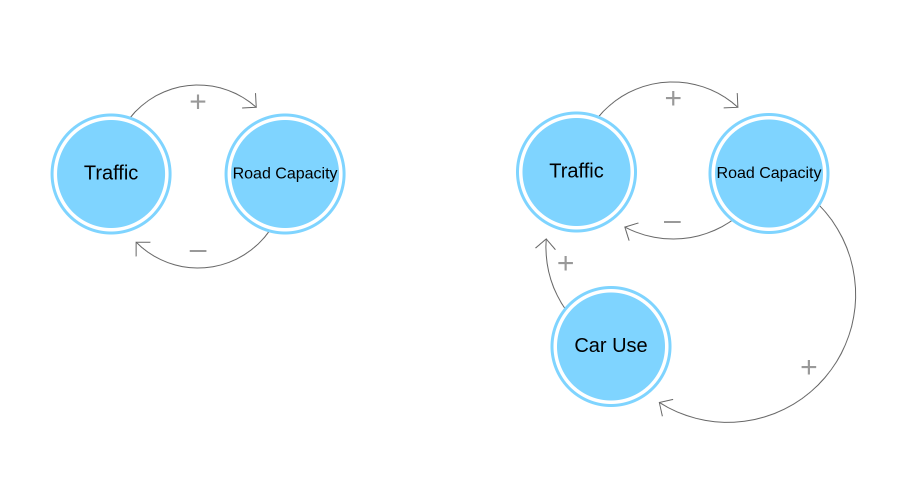
A system dynamics model of Induced Demand


What we have in reality is the system on the right. The increase in road capacity increases car use, and increased car use increases traffic. This is a “positive reinforcement” loop, which results in car use, traffic, and road capacity constantly increasing, in the “inexorably widening spiral” mentioned by Robert Caro above.

For those who might be a bit more interested in Systems Dynamics, this is an example of a systems archetype called “fixes that fail“: It is the situation where a short-term fix has side-effects for the long-term behaviour of the system.

(Once you understand this archetype, you start seeing it everywhere – people are not very good at systems thinking… If you don’t want to be one of these people, I highly recommend the book “Thinking in Systems” by Donella Meadows.)

I’ve created a simplified version of the system in LOOPY, an excellent tool for systems thinking, which you can try here. Click “Play” and then the blue button, and observe that on the system on the left, traffic is kept at a medium level, while on the system on the right, it keeps maxing out. (Road capacity can go down as well as up in this simple simulation, that’s why traffic does not stay maxed out.)

Closing this geeky interlude, where does all this leave us? It is clear that we don’t need more car lanes. This is starting to be understood even in the most car-centric places in the world (Texas, Los Angeles). Let’s not keep making that mistake in Greece. If you hear politicians talk about adding flyovers, get in touch with them and tell them it is a bad idea. Research shows that politicians are not good at judging public opinion (I will write a separate post about this), and they probably think that reducing car use is a non-starter with voters. Tell them otherwise.

As a last resort, tell them that if they don’t start learning from evidence collected over a century now, I will personally come and throw my copy of the Power Broker at them. It weighs one and a half kilos, it’s going to hurt.

Dimitra Blana is a biomedical engineer and health data scientist. Both in and outside her work, she enjoys modelling complex systems to better understand them.

With Linda, her red bicycle, she goes for coffee in the city, as well as camping trips in the countryside.

Dimitra is a recovering academic, planning how to make the city more beautiful and healthy for everyone, especially her young nephew.

Τηλέφωνο

(0030) 210 2016500

e-mail

info@citiesforcycling.gr

Διεύθυνση

Ψυχάρη 45, Αθήνα

Ακολουθήστε μας

© Copyright Cities for Cycling 2023, All Rights Reserved